
No. 9 3rd St., Banaba, San Mateo, Rizal (near Batasan Hills, Quezon City and Nangka, Marikina City Border) - Click here for google map pin
Smart No. : 09628434722
Email Address : smartbuildprime@gmail.com


Are you Earthquake Safe? Metro Manila, Laguna, Batangas, Cavite, Bulacan, and Rizal are highly prone to earthquake damage. Understanding your risk can help you take action to protect your home or building.
Key Factors in Earthquake Damage
-
Magnitude: Measures the earthquake's strength on the Richter scale.
-
Intensity: Describes how the earthquake is felt in a specific location, influenced by distance from the fault and soil conditions.
Earthquake Intensity Risk
According to PHIVOLCS, a Magnitude 7.2 earthquake in Metro Manila could result in an Intensity 8 to Intensity 9 event—ranging from "Very Destructive" to "Devastating." Even well-built structures can suffer significant damage at these intensities.
To ensure your building is earthquake-safe, consider the following:


From the Intensity Earthquake Risk Map above, it is shown that Metro Manila will likely suffer an Intensity 8 (Low 8 to High 8) to Intensity 9 (Low 9) or a Very Destructive Earthquake to a Devastating Earthquake according to PEIS or PHIVOLCS Earthquake Intensity Scale.

To ensure your building is earthquake-safe, consider the following:
1.) Proximity to Fault Lines
Structures within 10 kilometers of a fault line face a higher risk of damage.
-
The Valley Fault System Map covers Metro Manila, Laguna, Batangas, Cavite, Bulacan, and Rizal.
-
Properties near these faults may require structural assessments and retrofits.


2.) SOIL PROPERTIES
2a.) Soil Stiffness
The Metro Manila Map below is the approximate Soil Stiffness and Profile (After Saldivar Sali, 1992). Please take note that this is a generalization only.
NSCP (National Structural Code of the Philippines 2015) 208.4.3.1 Soil Profile Type and under Table 208-2 Soil Profile Types below:
Sa = Hard Rock
Sb = Rock
Sc = Very Dense Soil and Soft Rock
Sd = Stiff Soil
Se = Soft Soil
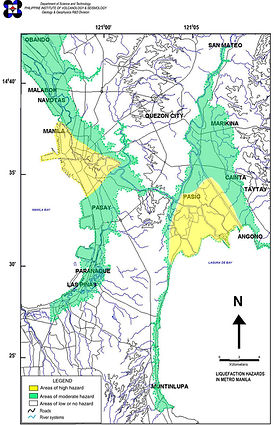
2b.) Soil Liquefaction Hazard
Liquefaction Hazard: Saturated soil may lose strength during shaking, behaving like liquid and compromising structural stability.
Liquefaction Hazard Map of Metro Manila (2001). Source: PHIVOLCS

3.) Professional Design and Construction
-
Use structural modeling and seismic analysis to ensure safety.
-
Structures built according to the 2015 National Structural Code of the Philippines (NSCP) can safely withstand Intensity 8–9 earthquakes according past ASEP Presidents.

4.) BUILDING / STRUCTURE DESIGNED AND CONSTRUCTED USING UPDATED 2015 NSCP (National Structural Code of The Philippines)
- The Structural Code has been updated in 1992, 2001, 2010 and most recently last 2015. Structures built and designed before 1992 are prone to Earthquake Damage as the structural design may not resist Earthquake forces. Structures designed and constructed using the 2015 National Structural Code can safely resist a magnitude 8 to 9 Earthquake according to past ASEP Presidents.

Contact us for a structural assessment and a structural retrofit design (structural strengthening of existing structure) could be needed for your structure.
Suggested Links:
http://newsinfo.inquirer.net/692133/do-you-live-in-quake-zone-new-phivolcs-maps-trace-100-km-west-valley-fault
http://www.mmda.gov.ph/index.php/20-faq/297-safety-of-ph-structures-during-quakes
keywords: house construction
contractor architect Philippines
list of contractors builders
construction company